

Is Camera Flash Bad For Kittens
Using wink when photographing animals is something of a controversial field of study. It'southward an advanced technique, bringing benefits for the photographer, such as the power to capture unique photos at nighttime, freeze loftier-speed action, and fill ugly shadows. Yet as shortly as yous mention flash and animals in the same sentence, you're probably going to exist met with lots of comments well-nigh it beingness 'unethical' or 'harmful'.
But these comments are often speculation, born from a passion for wildlife rather than based on an actual understanding of an fauna's physiology. As both a photographer and zoologist, this makes me realise at that place is a definite lack of agreement. In this commodity, I am going to address the issue of wink photography with wildlife by looking at scientific inquiry and observations made in the field, alongside comments from an skillful in sensory ecology.

The Structure of the Retina
 The retina is a light-sensitive layer at the back of the eye, fabricated up of photosensitive cells that convert light free energy into signals that are carried to the brain via the optic nerve. There are two types of these photoreceptors: rods and cones. Rods are responsible for vision at low low-cal levels, and cones are responsible for colour vision at loftier calorie-free levels. The ratio of rod to cone cells, and the actual structure of the eye, varies greatly between species.
Photoreceptors contain different pigments which absorb low-cal energy, assuasive for its conversion into electrical signals. But if these photoreceptors are exposed to also much light, the pigments bleach and must be recharged. This is what happens when you lot look at a bright lite and then detect your vision is dumb temporarily. This is the consideration when thinking about the effect of wink photography.
Flash Photography with Animals
There is a existent lack of scientific research into the result of bogus low-cal on animals. And so actually, the reply to the question of 'does flash photography impairment animals?' is merely speculation. Consequently, no ireally knows a definitive reply. Having said that, there is some truth that tin can be derived from the understanding of the eye and the smatterings of research that are bachelor at the moment.
When photographers use flash with animals, it is rarely at full power. A flashgun allows you to adjust the power output, and photographers will actually be shooting between 1/8th and 1/64th power nearly of the time. There is a real difference betwixt a flashgun firing at full power and at these lower levels. I've flashed myself in the confront at nearly ane/16th power and institute that whilst it was dazzling when very shut to me, it was endurable and I didn't experience any blotchy vision.
Read more than: A Guide to Using Wink with Wildlife
Dr Martin Stevens is an Associate Professor in Sensory and Evolutionary Ecology at the Academy of Exeter, England. When I asked his opinion on the matter he said, "dissimilar animals have unlike sensitivities to light, and this will depend on how bright the light source is and how adjusted their eyes are to the electric current light conditions". Clearly the effect that flash photography may have depends on the ambient low-cal weather too.
"Information technology depends on the species, no uncertainty, but pretty much all birds at night will have their photoreceptors adapted to night weather and hence be very sensitive to bright lights and potentially temporarily blinded by sudden bright calorie-free sources," said Dr. Stevens. "Withal, the expiry of an beast is very unlikely from the flash itself." This brings concerns that wink could hinder the power of nocturnal birds to chase successfully.
It is also worth noting that flashguns produce a diffused light beam and not a highly focused beam, such as with a laser. In fact, the utilise of strobe lighting to test for retinal disease is commonplace. It is truthful that the use of flash does non result in permanent harm to the heart.
What Does Scientific Research Say?
There is research looking at the effects of photography on the West Indian Anole (Anolis cristatellus), accounted necessary due to ecotourism in the area. The written report found that the reptiles really performed a threat brandish in response to camera shutter sounds, something that would be expected if a predator was nowadays. But importantly they found at that place was no response to the utilise of flash.
Another piece of research, this fourth dimension looking into the effect of wink photography with seahorses (Hippocampus whitei), concluded that the utilise of wink underwater is a 'safe and viable technique' past defined. They institute no significant behavioural responses from seahorses when exposed to flash.
Research from 1991, looking at monitoring animals with cameras, used a camera trapping technique: the triggering of a camera and flash units by the breaking of an infrared axle. Within the research paper the author comments on the regular capture of one particular cherry fob (Vulpes vulpes), stating "evidently the animal was not disturbed by the presence of the camera or flash". Whilst this newspaper was not looking at the event of wink photography direct, it is noteworthy that they came to this determination.
Other than that, research into the upshot of flash is nonexistent. So let'southward move on to what else nosotros can decide about the use of wink with animals.
Further Considerations
 At that place is a lot that can be learned from observations of the behavioural response of an brute when exposed to flash. Personally, I have used flash with a troop of woolly monkeys in the Amazon rainforest, necessary due to the thick awning and harsh lighting that is present. Non once did the animals react to the wink. Prior to me fifty-fifty unpacking my camera, the monkeys were coming closer to investigate me. The wink didn't alter this reaction; it didn't make them run.
You can run across in the photo that this detail private was looking direct at the flash, but appeared to experience no discomfort. Furthermore, any affect of flash would no doubt be lessened should an animal be looking away from the flash unit.
Camera trapping is a technique used by many photographers nowadays, with flashes firing when remotely triggered by the presence of an animal. I've used this technique myself, and the i affair I accept noticed is that the majority of animals walk looking downwards. They aren't looking direct at the photographic camera flashes when they burn down.
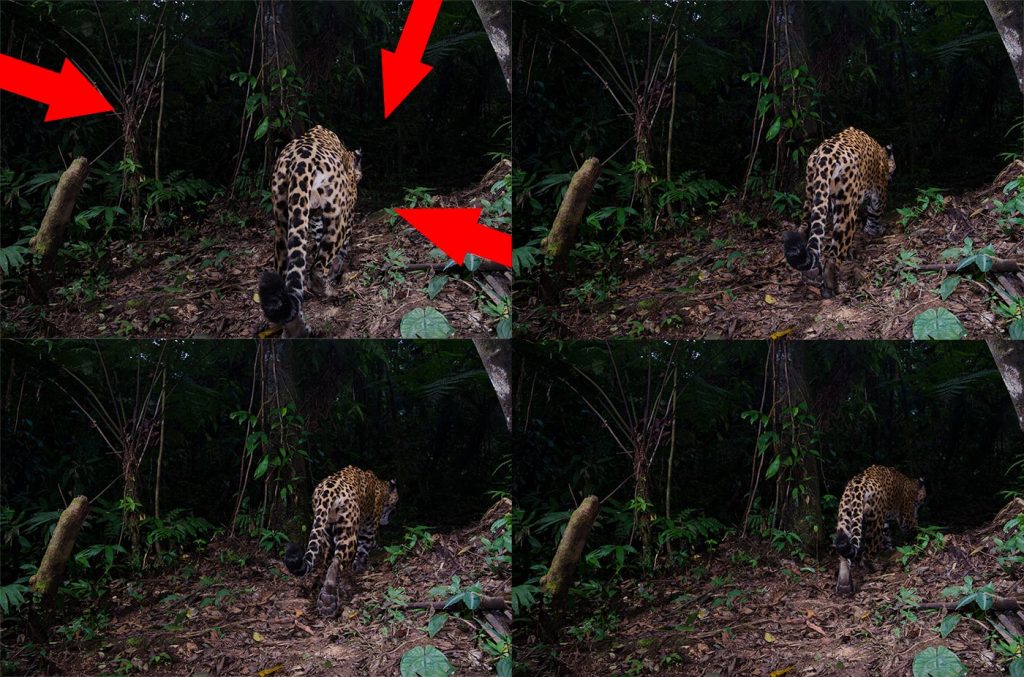
I have twice caught a jaguar in my camera trap, and both times the camera fired multiple frames in quick succession. There was no response from the jaguar, and it continued its journey undeterred by the flashes. A trail camera (with no flash) captured the same jaguar further downwards the trail moments later on, and information technology was still walking as normal with no visible disturbance. Personally, I believe that they encounter these flashes no differently to lightning in a thunderstorm. Whilst this is extremely depressing for me equally a photographer to take to relive the moment I defenseless a jaguar, but facing the wrong fashion, you can clearly see the lack of response in the sequence below.
I accept also photographed hummingbirds using flash many times, and there was admittedly no alteration in their behaviour. The birds connected to fly around the flowers whilst existence exposed to rapid firing of a wink, and also repeatedly returned to the same spot undeterred.
In Conclusion
Looking at the express available testify, we can class some sort of speculative conclusion that points to the probable consequence of flash with animals.
The effect of flash appears to be insignificant in daylight. Each species is different, of course, but I would advise that in general wink photography does not cause impairment or distress to animals when ambient light weather condition are adequate. If you do cull to apply wink with wildlife, consider the behavioural response of the animal in question.
It is safe to say that nocturnal animals, especially birds, will most likely feel some sort of temporary incomprehension from exposure to flash at night. Just this is temporary, and lasting for perhaps 5-20 minutes earlier the photoreceptors are fully recharged. It is true that this could hinder the ability to hunt or spot a predator. With no directly permanent damage, the consideration here is a moral ane and downwards to the photographer. However, I would propose to err on the side of circumspection and not use flash with nocturnal birds.
Wink photography at night does present potential effects, and so information technology is important to be considerate. If y'all are directly behind the camera, then you should consider firing only a few frames before moving on. Peppering an animal with constant bursts of wink is most definitely unethical. With camera trapping you have less control, but since your flashes are not in the direct line of sight of your subject then chances are their bear upon is minimal. As always, if an animal appears to be distressed by your actions then you should end them immediately.
Finally, please read our articles on 'The Ethics of Wildlife Photography' and 'A Guide to Using Flash with Wildlife' for further information.
Source: https://www.naturettl.com/does-flash-photography-harm-animals/
Posted by: waltersrehe1947.blogspot.com
0 Response to "Is Camera Flash Bad For Kittens"
Post a Comment